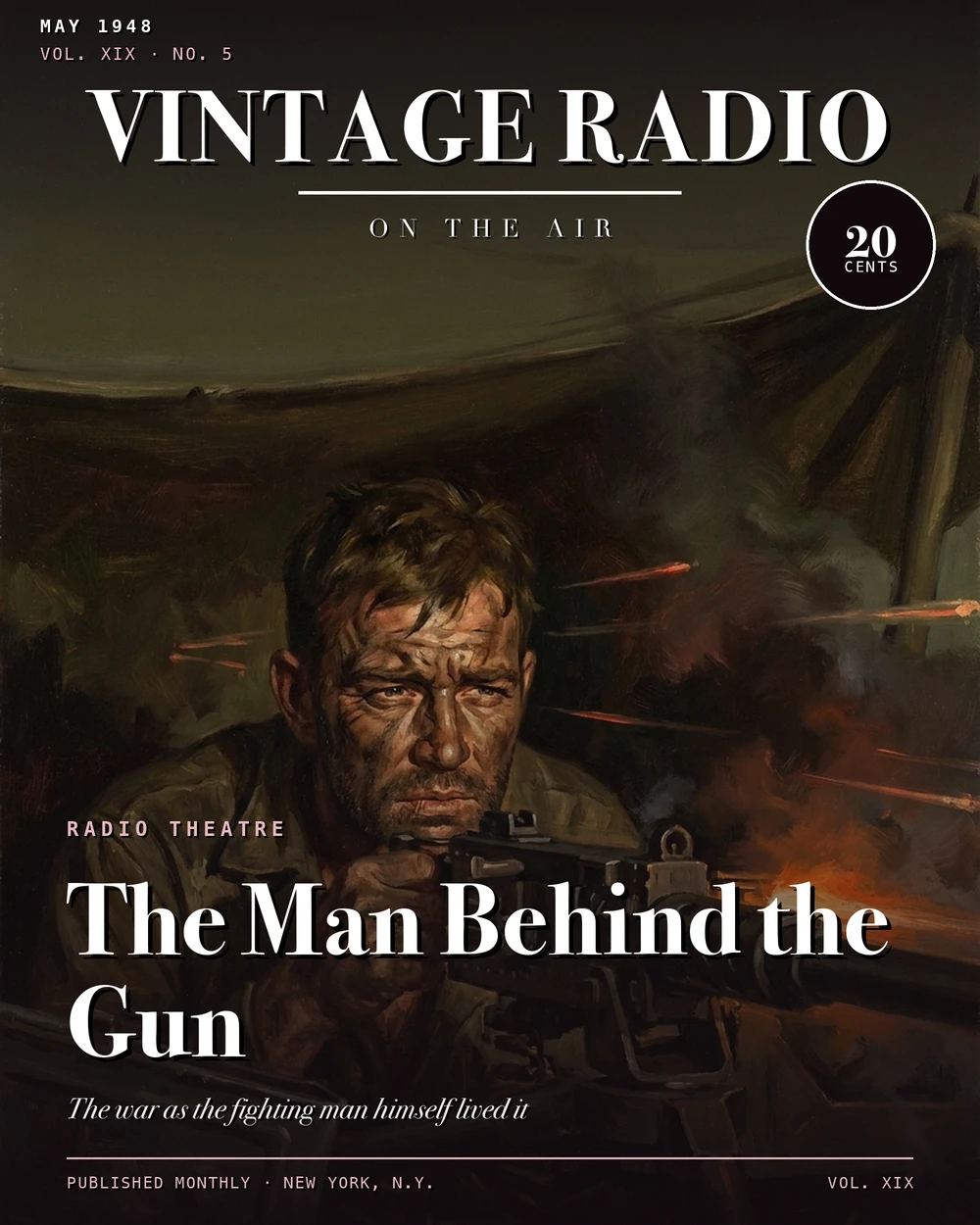
The Man Behind the Gun
What Made It Different
Most war programming in 1942 dealt in abstractions — the cause, the enemy, the stakes. The Man Behind the Gun went somewhere more specific. Each episode centered on a single fighting man: a tail-gunner over the Pacific, the skipper of a torpedo boat, a submarine crew operating beneath the waves. The show's stated purpose was to tell how the man behind the gun lives, what his duties are, and what the stories are behind the weapons he uses. That narrow focus was the whole point. Stories were narrated in the present tense from a second-person viewpoint, placing the listener inside the hero's experience rather than reporting from a safe distance. Characters were written as boys from down the street, not larger-than-life heroes, and the New York actors cast in those roles were specifically valued for their ability to reproduce speech patterns from across the United States.
The series described its stories as "based on fact" while noting that names and characterizations were "wholly fictitious." That combination gave director William N. Robson and his writers the freedom to construct composite portraits of fighting-man types without being bound to the limits of any single documented account. It was a practical solution with artistic consequences — the stories could be shaped for dramatic effect while the underlying research gave them credibility that purely invented war drama couldn't match.
The Man Behind the Gun ran on CBS from October 7, 1942 to March 4, 1944, completing 74 episodes across its roughly eighteen-month run. It won a Peabody Award in 1943 as radio's outstanding dramatic program, took Billboard's "top documentary program" citation three times, and drew a New York Times notice from critic John K. Hutchens, who wrote that the show "reproduces with extraordinary fidelity the sounds and mechanics of war." Variety reviewed the premiere on October 14, 1942, calling it "an engrossing show, alive with atmosphere and crammed with action" that was "expertly produced with excellent sound effects and a number of vibrant performances."
The Research Behind the Stories
The show launched as a sustaining program, with no commercial sponsor, and during its early weeks listeners heard public-service announcements in place of ads — including appeals for nurses to apply for overseas commissions with the Army Medical Corps, where 2,000 nurses a month were needed. There was a kind of coherence to that arrangement. A show this committed to documenting how actual fighting men did their work fit naturally alongside that kind of wartime messaging.
The research effort behind the scripts was substantial. By February 1943, Robson had traveled approximately 10,000 miles for the series. He flew in bombers, fired military guns, and sailed on military ships. Robson and writer Ranald MacDougall visited New London, Connecticut to learn about submarines, Fort Knox, Kentucky to observe the tank corps, and Norfolk, Virginia to study aircraft carriers — all in a single three-week span. MacDougall, over one two-week stretch, traveled on a destroyer taking what were described as "bundles of meticulous notes," then spent time on a training submarine that made about eight crash dives. When the USS Boise limped into the Philadelphia Navy Yard after the Battle of the Coral Sea, Robson and MacDougall went there to interview the crew and examine the ship directly. That reporting became the basis for a two-part episode that aired in March 1943.
Robson said that soldiers, sailors, and Marines who listened were quick to notice technical errors and eager to point them out, which only reinforced the research mission. The show's knack for timing its stories to actual events became part of its reputation. In August 1943, Variety noted that The Man Behind the Gun had "socked the bell again" with a dramatization about the capture of Kiska broadcast just eight hours after the announcement of the actual event — the second such instance in recent weeks. Robson had scheduled that script on a hunch "that something was about due to pop in the Aleutians." Earlier, anticipating an Allied invasion of Sicily, he had sent writer Allan Sloane to Massachusetts, where engineers were training in beachhead landing techniques. When news of the Sicily invasion broke on a Friday evening, Robson called Sloane and told him the script needed to be ready because it would air on Sunday.
The Production Team
Robson's commitment to the show was total. He said, looking back on it roughly 45 years later, that working on The Man Behind the Gun was a full-time job — he did not take other assignments while producing it. Each broadcast required two days of rehearsal. Precision was essential, particularly in battle scenes, where actors, narrator, music, and sound effects had to be coordinated on a split-second basis. Robson's stated policy on actors who couldn't match that dedication was direct: "You did it my way or else."
The production setup was unusual in a specific technical way. Robson placed two 18-inch speakers in the studio on the dead sides of the cast microphones — the dynamic mikes in use had two live sides and two dead sides. When gunfire or aircraft sounds played through those speakers, the actors had to raise their voices to be heard above the noise. The effect on their performances was real rather than simulated. A New York magazine editor who witnessed a broadcast compared Robson's two-handed direction style to Toscanini conducting the NBC Symphony. Robson described it himself: "Everything came off my fingers… everything."
The idea for the series came from Ranald MacDougall, who was born in Schenectady in 1915 and had been working in radio since his mid-teens, initially as a staff writer for NBC. MacDougall had left school before finishing the eighth grade to help support his family, worked as a page at Rockefeller Center alongside Gregory Peck, and wrote scripts under pseudonyms before landing staff work at the network. By the time The Man Behind the Gun launched, his radio career was substantial enough that The New York Times had run an interview piece on him at age 27. He left radio in 1944 to sign with Warner Bros., and his second film script — Mildred Pierce, starring Joan Crawford — earned him an Academy Award nomination for Best Screenplay.
Robson, born in Pittsburgh in 1906, had graduated from Yale with a degree in philosophy in 1928, joined CBS in 1933, and eventually succeeded Irving Reis as head of the Columbia Workshop. He likened directing the show to conducting a symphony, and that was not an idle comparison — the music side of the production generated its most documented conflict. Composer Bernard Herrmann, then chief conductor of the CBS Symphony Orchestra, clashed with Robson over the use of a robust musical theme. Herrmann's argument was blunt: "You wanna win the war with music, get Wagner's music! Don't get my music! I can't win the war with my music!" Herrmann departed after that disagreement, and Nathan Van Cleave replaced him and provided the larger sound Robson wanted.
The narrator situation produced its own friction. Everett Sloane, one of radio's busiest actors, argued that he didn't need the two days of rehearsal Robson required. Robson's response was that even if Sloane didn't need it, Robson himself did. Sloane left, and Jackson Beck took over the narration for the remainder of the run. Beck, who had begun his radio career in 1931 and was already one of the medium's most reliable narrators, would later become widely recognized as the announcer-narrator of The Adventures of Superman.
The Writers and Cast
The writing staff brought in for The Man Behind the Gun included names that went on to significant careers elsewhere. Arthur Laurents, who graduated from Cornell in 1937 and went directly to CBS as a radio drama writer, worked on the series before being drafted and assigned to the Army Pictorial Service writing training films. He later wrote the librettos for West Side Story and Gypsy. Allan Sloane, Robert Lewis Shayon, and Forrest Barnes also contributed scripts, along with MacDougall himself, and subsequent research has added Louis Pelletier and David Harmon to the list.
The cast was drawn from New York's Radio Row — the pool of working radio actors based in the city — and included Myron McCormick, Bill Quinn, Larry Haines, and Paul Luther. The voice of Frank Lovejoy can also sometimes be identified in surviving episodes, though the series was not generous with acting credits. Sound effects were handled by Ralph Curtiss, Paul Mowry, and James Rogan, whose work shaped the intensity that Robson was after.
The Sponsor Years and the End of the Run
The show debuted opposite the second half of Kay Kyser's College of Musical Knowledge on NBC, which ranked in the country's Top 50 for three consecutive years. Launching at 10:30 p.m. against the season's highest-rated music show was a structural disadvantage the program couldn't fully overcome in its initial period. It ran without a sponsor until March 1943, when the Elgin National Watch Company came on board. Variety endorsed the sponsorship days after it was announced: "The trade looks on this sponsorship by Elgin as one of the smartest buys made in network radio for some time."
The Elgin deal moved the show to Sundays at 10:30, following Phil Baker's comedy quiz Take It or Leave It, and the series achieved a 9.2 rating in the 1942–43 season. Elgin's first 13-week contract expired at the end of May 1943; the show went on summer hiatus before resuming under a second Elgin contract in September, now airing Saturdays at 7 p.m. on 61 Columbia stations. When that contract ended, the show continued on original and repeat programming until the final broadcast on March 4, 1944, by which point the season rating had fallen to 4.9.
The Peabody Award citation, formally a 1942 award for "outstanding entertainment in drama" presented to CBS Radio, praised the series as "brilliantly written by Ronald R. MacDougall and authentically produced by William Northrup Robson," singling out its "timeliness, a racy dialogue and a vivid sound effect which intensify our appreciation of what the men in action are up against." Only a handful of episodes survive from the full run of 74, and the surviving recordings are in marginal audio quality — a significant loss for a series that OTR researcher Jim Ramsburg described as "an often overlooked CBS entry" whose late-night scheduling at launch kept it from reaching the audience it earned.